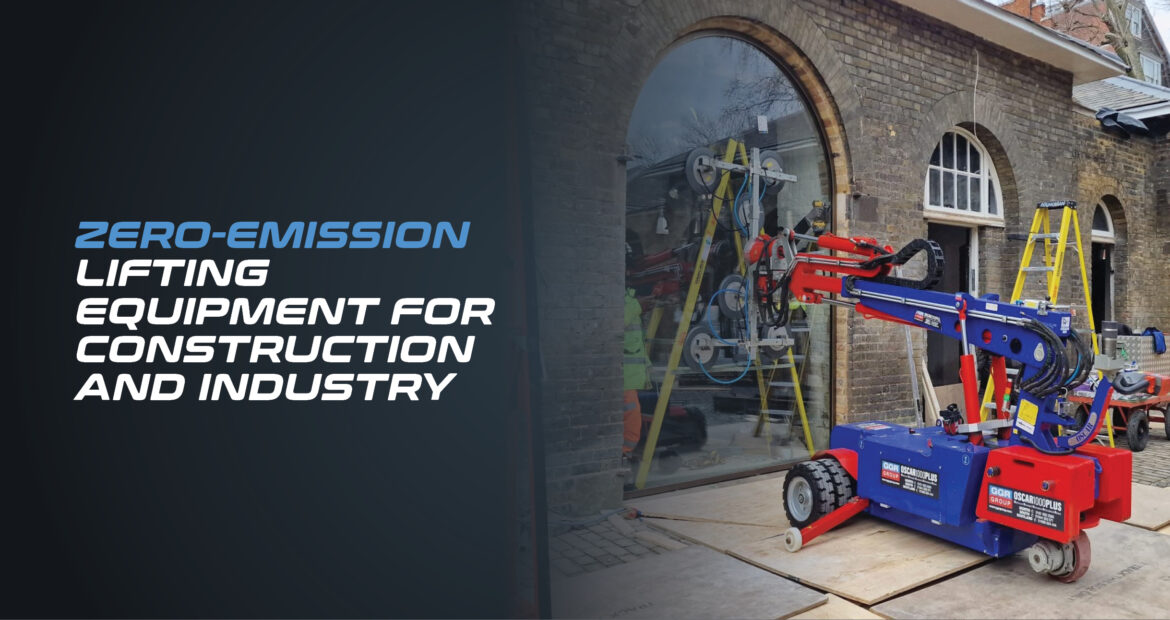
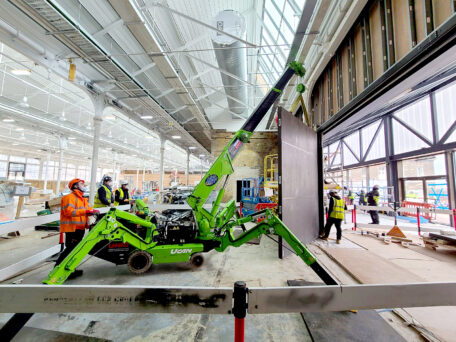
Electric and battery-powered lifting equipment is becoming an increasingly practical option across construction, glazing and industrial projects, particularly where machinery needs to operate indoors, close to occupied buildings or on sites with tighter emissions and noise requirements.
This change is being driven by changing expectations around construction plant. In London, the Non-Road Mobile Machinery (NRMM) Low Emission Zone places minimum emissions standards on qualifying machinery used on construction and demolition sites, with the requirements becoming progressively tighter. This wider move towards cleaner construction is increasing demand for equipment that can reduce exhaust emissions at the point of use without compromising lifting capability.
GGR Group offers a growing range of electric and battery-powered lifting equipment, including ECO mini spider cranes, battery-powered articulated crawler cranes, electric telehandlers, glazing robots, vacuum lifters and portable power solutions.
Electric Spider Cranes for Restricted-Access Lifting
Electric spider cranes combine compact dimensions with lifting capability and electrically powered operation, making them particularly useful where access, local exhaust emissions and noise are important considerations.
ECO Spider Cranes
GGR Group’s ECO mini spider cranes are designed for lifting in restricted-access environments while operating electrically.
Typical applications include:
- Indoor construction
- Shopping centres
- Airports
- Factories
- Fit-out projects
- Urban developments
- Glazing installations
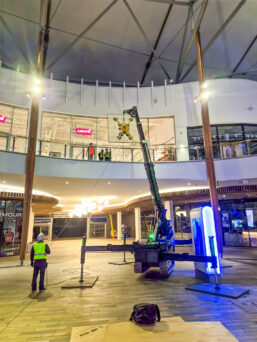
Their compact dimensions can help them travel through restricted access points before deploying for lifting, while electric operation avoids local exhaust emissions at the point of use.
CDMER Spider Cranes
Selected CDMER spider cranes offer flexible power arrangements, including diesel-electric operation and the option to operate from a suitable 400V mains electrical supply. Models include: 095, 295, 295-110v, 295-2, 376, 506, 546, 546-2, 547, 706, 702-2, 806, 806-3, 1006, Cube Crane.
This can be useful on projects where the crane needs to work in both outdoor and indoor environments.
For example, a machine may operate using diesel power externally before switching to mains-electric operation inside a building.
When operating from diesel, the crane is not zero emission. When running from a suitable electrical supply, however, it can operate without producing tailpipe emissions at the working point.
Battery-Powered Articulated Crawler Cranes
Battery-powered articulated crawler cranes combine tracked mobility, articulated lifting and electric operation. They can be particularly useful where loads need to be moved through a building before being lifted into position, or where access restrictions make larger conventional cranes unsuitable.
The articulated boom can help operators work around structural obstructions and within complex internal layouts, while tracked travel supports movement through confined working areas.
TMC 400 Li-Ion Articulated Crawler Crane
The TMC 400 Li-Ion Articulated Crawler Crane uses lithium-ion battery power and offers:
- Maximum lifting capacity of 4 tonnes at 2 metres
- Approximately 1.2m machine width
- Maximum lifting height of up to 21.1m with jib
- Pick-and-carry capability of up to 1.6 tonnes
- Zero tailpipe emissions during battery operation
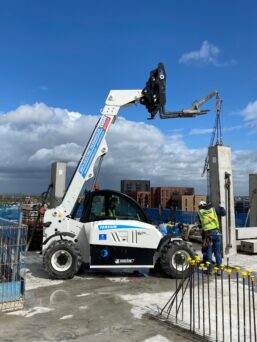
Its combination of compact access, tracked movement, articulated lifting and pick-and-carry capability makes it well suited to internal construction, steelwork installation, machinery movement and other specialist lifting projects.
Electric Telehandlers for Material Handling
GGR Group’s electric telehandler range provides material handling capability without tailpipe emissions during electric operation, with battery options that allow the machine specification to be matched more closely to the expected working cycle.
6.26 Electric Telehandler
The 6.26 Electric Telehandler has a 2.6-tonne lifting capacity, a maximum lifting height of 5.9m and a maximum working radius of 3.1m. GGR Group currently offers three battery configurations across the range: 330Ah, 440Ah and 560Ah.
Depending on battery configuration, approximate runtime can extend from up to 6 hours for standard/intermittent duties, to up to 8 hours with the extended battery and up to 11 hours with the highest-capacity option. Runtime will vary according to load, travel, attachment use and site conditions.
Charging options are designed around different working patterns. The standard battery version can recharge in approximately 3 hours 45 minutes using a standard external three-phase charger, while an optional fast charger can reduce this to around 1.5 hours. Lithium battery technology also makes opportunity charging practical, allowing the machine to be topped up during breaks or natural pauses in the working day.
17.45 Electric Telehandler
For higher-reach applications, the 17.45 Electric Telehandler offers a 4.5-tonne maximum lifting capacity, a maximum lifting height of 16.4m and a working radius of 12.6m. Its 45kWh battery is designed to provide up to 8 hours of non-intensive use or around 3.5 hours of intensive use.
An onboard charger is supplied as standard, with approximately 0-80% charge in 4 hours and a full charge in around 6 hours. A universal charging socket allows the machine to work with different site power arrangements, including single- and three-phase supplies, helping contractors plan charging around the available infrastructure.
Battery-Powered Glazing Equipment
Glazing projects often involve more than simply lifting glass into place. Units may need to be unloaded externally, transported through a building, moved between floors and positioned accurately within restricted installation areas. Doorways, corridors, lifts, atriums and finished floor areas can all affect the type of equipment that can be used.
Battery-powered glazing equipment is particularly useful in these environments because it combines compact access with controlled handling while avoiding exhaust emissions at the point of use. This can be especially relevant on internal fit-out projects, occupied developments and high-rise glazing work where equipment may need to travel through completed areas before reaching the installation point.
Oscar Glazing Robots
The Oscar range of glazing robots, including the Oscar 600 and Oscar 1000, uses battery power to transport, manipulate and position glass. A glazing robot can combine glass transport and final positioning within one compact machine, helping move units from their storage or delivery point towards the installation area.
Typical uses include internal glazing, inside-out glazing, multi-storey developments, restricted-access installations, finished environments and moving glass between floors using suitable lifts.
Battery-Powered Vacuum Lifters
Battery-powered vacuum lifters form another important part of GGR Group’s glazing equipment range. Rather than relying on an engine at the lifting point, the lifter uses its onboard electrical system to create and monitor vacuum, allowing suitable glass units to be handled with controlled suction.
Depending on the model, vacuum lifters can provide powered or manual rotation and tilt to help orientate glass during installation. Different configurations are available for larger or heavier units, vertical and horizontal handling, curved or specialist glass, restricted-access glazing and internal or external installation.
They can be used below spider cranes, glazing robots, overhead lifting systems and other suitable lifting machinery. The correct lifter should be selected around the weight and dimensions of the glass, its surface characteristics, the required orientation and the conditions in which the lift will take place.
Portable Power with ECube Lithium Battery Packs
ECube lithium battery packs provide portable electrical power for compatible lifting equipment and tools such as mini spider cranes, pick-and-carry cranes, glazing robots, tracked carriers and tracked levellers, as well as site tools and lighting.
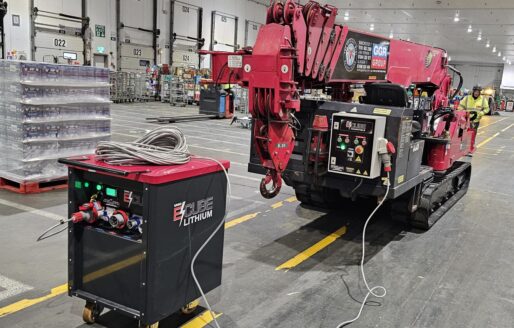
They can help reduce reliance on conventional generators or fixed power supplies where suitable mains power is not available close to the working area.
Benefits include:
- Lithium battery technology
- Portable electrical power
- Support for compatible electric equipment
- Ability to charge while in use where applicable
ECubes can be particularly useful on larger or changing sites where electrically powered equipment needs to operate away from established power infrastructure.
They do not automatically make every connected machine completely zero emission, as this also depends on how the battery itself has been charged.
Other Electric Lifting Equipment
Electric and battery-powered options are also available across other parts of GGR Group’s range, including electric pick-and-carry cranes, battery-powered tracked carriers and other specialist material handling equipment.
Electric pick-and-carry cranes can provide a useful solution for machinery movement and industrial lifting where loads need to be lifted, transported and repositioned within the same facility. Battery-powered tracked equipment can support the movement of heavy or awkward materials through restricted areas while keeping local exhaust emissions low at the working point.
Contact GGR Group today for help selecting the best zero emission lifting solutions for your project.
Trackback URL: https://www.ggrgroup.com/news/zero-emission-lifting-equipment-for-construction-and-industry/trackback/